
In 2012, Kimberly Hamilton, now 35, graduated from grad school with $45,000 in student loan debt. She didn’t understand how interest worked but soon learned that if she paid off her debt in 10 years as prescribed, she would pay nearly 50% extra due to interest.
“At first, I was super angry,” she says.
She had goals for her money, including buying a home and starting a family.
To add insult to injury, she was living in Washington, D.C., one of the most expensive cities in the country, she didn’t understand how to pay down debt, and her starting salary out of grad school was only $40,000.
The whole situation was “really defeating and anxiety-producing,” she says.
However, rather than let the debt defeat her, she decided to do whatever she could to turn her financial situation around.
Here’s exactly what she did to pay down her debt:
Note: This post may contain affiliate links that allow this blog to earn money without a cost to you. Many thanks if you use them. Please read my disclosure for more info.
Getting Educated
“I started getting educated about money by reading and listening to everything under the sun that I could about personal finance.” She read I Will Teach You To Be Rich by Ramit Sethi and scoured the Learnvest blog for relatable advice.
Understanding Compounding Interest
“The first part for me was learning what compounding interest is.” According to the U.S. Securities and Exchange Commission, compound interest is “the interest you earn on interest.” However, if you are in debt, instead of earning interest on interest, you are paying interest on interest.
Once Kimberly understood how compounding interest worked and how expensive it would be over time, she realized she needed to “pay the debt down as quickly as possible.”
Coming up with a Plan
She decided to use the avalanche method to pay down her debt. To do this, she listed out all of her debt and the associated interest rates. Then, she made the minimum payments on all of her debt and made payments above the minimum on her highest-interest-rate debt. “The avalanche method gives you your biggest bang for your buck,” she says, by “bringing down the principal faster.” Originally, her minimum payment was $503.93, but by the end of her debt payoff journey, she was putting $1,500 to $2,000 towards her debt per month.
Reducing Living Expenses
Where did she find the extra money to make larger debt repayments? She kept her living expenses low by having three roommates and keeping clothes and food expenses low. But with a $40,000 yearly salary in a high-cost-of-living city, “there’s only so much you can reduce.”
Learn more:
Working Side Jobs
So, she decided to work to increase her income. “I did take up every side job imaginable,” she says. She was a mystery shopper, she gave out samples at a local liquor store and would find things at yard sales and sell them on Craigslist. Whatever she could do to make extra money, she would do.
Learn more:
- Side Hustle Ideas: Over 200 Ways to Make Money on the Side
- 9 Easy and Profitable Online Work at Home Jobs
Negotiating her Salary
Every year, she was relentless in negotiating her salary. While she didn’t get a raise every year, she says she received “significant increases over the years.” For other people looking to ask for a raise, she recommends preparing for the conversation in advance and tracking the results-focused contributions you’re making. She also recommends having a one-pager ready, especially if you work for a larger company. The one-pager acts as a tool you can use when having a salary conversation with your boss, and then your boss can use it to talk to the people above them to make a case on your behalf.
Finally, if your boss says, “No,” remember, that’s your window to ask, “What can I do in the next 6 months?” she says. Go in with an open mind, and ask about the tangible actions you can take to make a raise possible.
Learn more:
Continuing to do What She Enjoyed
One crucial aspect Kimberly mentioned about her debt-payment journey was that she didn’t forget to live life. “I am all about spending money on things that really make life enjoyable.” For her, that was travel. During her debt payoff journey, she traveled to Vietnam, the Philippines, Indonesia, Cartegena, San Juan, and Miami, to name a few. One way she afforded this was by extending work trips when her employer paid for her flight.

Becoming Debt Free
After employing the above strategies, it ultimately took Kimberly just over 3 years to pay down $45,000 of debt, plus the interest accrued during that time. Not only did she benefit from having additional disposable income once she became debt free, but she also had more confidence. She thought, “If I was able to learn all that in the past three years, imagine where I could go in the next three years.”
Want to boost your confidence?
- Free Webinar: How to Be Confident- 3 Secret Strategies to Optimize Your Life for Success & Happiness
Purchasing a Home
Once she successfully paid off her debt, she benefited from having the habit of saving $1,500 to $2,000 per month. So, she decided to start setting that money aside to buy a home so she “didn’t have to live with 3 roommates anymore.” It took around 2 years for her to meet this goal, and in 2017 she saved enough to put down 10% on her first home.
Becoming a Published Author
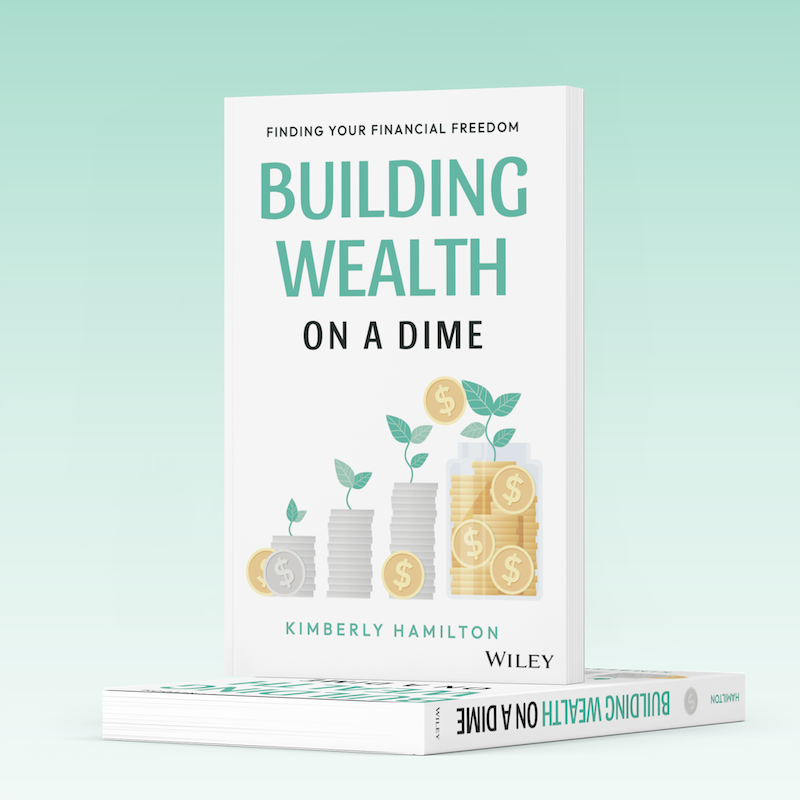
In 2019, Kimberly started her company, Be Worth Finance. The inspiration for her business came when she shared her story in a book club and realized that the smart, well-educated women in her group lacked basic financial knowledge, just like she did when she got out of college. Then, in 2021, a publisher approached her and asked her if she’d be interested in writing a book to give people everywhere the roadmap to create financial freedom as she had.
Kimberly’s book Building Wealth on a Dime is available now wherever books are sold.